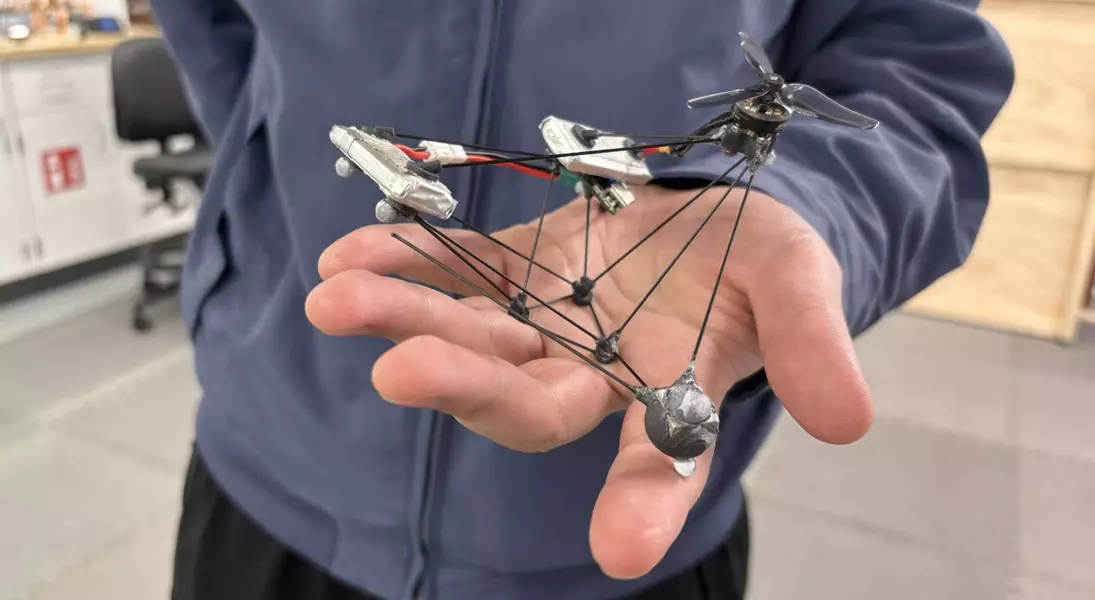
A team of engineers at Northwestern University has developed an innovative drone prototype, the "Phantom Twist," that achieves near-invisibility by rapidly spinning its entire body. This groundbreaking design, which rotates up to 25 times per second, makes the drone appear as a blurred, semi-transparent smudge, significantly reducing its detectability compared to traditional quadcopters. The project addresses the critical issue of drone visibility, which can alter the behavior of observed subjects in applications like wildlife monitoring and infrastructure inspection. While still in its experimental phase, the Phantom Twist showcases a novel approach to stealth technology, utilizing AI to optimize its physical configuration for stable flight and visual obfuscation. The research highlights the potential for advanced engineering and artificial intelligence to create more discreet aerial observation tools, although practical challenges such as integrating functional imaging systems and addressing potential privacy concerns remain.
The drone's unique design involves its single motor spinning the main body in one direction and the propeller in the opposite direction, eliminating any stationary components that the human eye could fixate on. This mechanism ensures that the entire drone blurs into its background, offering an advantage over conventional drones where only the rotors move, leaving the main frame clearly visible. The development process leveraged advanced AI, which analyzed 20,000 potential drone layouts and optimized the placement of components to prevent visual overlap during rotation. This iterative design, refined through simulations against various real-world backdrops, resulted in a highly effective visual camouflage. The project, funded by the National Science Foundation, currently focuses on minimizing environmental impact in scientific observations, and the team acknowledges the need for further development to incorporate stabilized camera technology and address ethical implications before any real-world deployment.
The Ingenious Design of the Spinning Drone
The "Phantom Twist" drone employs a radically different design philosophy to achieve its near-invisible state, moving away from the static body and multiple rotor setup of conventional quadcopters. This prototype features a single motor that drives both the main airframe and a single propeller. Crucially, the airframe spins rapidly in one direction, while the propeller rotates in the opposite direction. This synchronized counter-rotation ensures that no part of the drone remains stationary relative to the ground, preventing the human eye from locking onto a distinct shape. Instead, the drone's components blur into a faint, translucent haze against the sky or landscape, rendering it significantly less conspicuous. This innovative mechanical arrangement is central to its ability to become an almost imperceptible presence during flight, making it roughly ten times harder to detect than a standard drone.
Developing a drone that can maintain stable flight while rotating at such high speeds (up to 25 times per second) presented considerable engineering challenges. To overcome these, the research team at Northwestern University utilized an AI-powered design pipeline. This process began by generating approximately 20,000 different drone layouts, each evaluated for flight stability. Subsequently, optimization algorithms meticulously reconfigured the positions of essential components—including the motor, propeller, circuit board, battery, and counterweights—to eliminate any visual overlap when the entire unit is spinning. These candidate designs were then simulated against 100 diverse real-world photographic backgrounds. A sophisticated model, approximating human vision, scored each design based on its visual detectability. The 500 top-performing designs underwent further optimization, culminating in the final prototype that effectively disperses its physical form into a soft, indistinct blur when in motion. This ingenious application of AI and mechanical design capitalizes on the limitations of human perception, demonstrating how motion can be leveraged to create effective visual camouflage.
Future Implications and Ethical Considerations of Stealth Drone Technology
While the "Phantom Twist" drone represents a significant scientific advancement, it remains a university research prototype, far from commercial readiness. The current model, funded by the National Science Foundation, primarily targets applications in scientific research, such as minimizing disturbance to wildlife during observation or enabling less intrusive infrastructure inspections. However, several practical and ethical hurdles must be addressed for broader application. One immediate technical challenge is the integration of a functional imaging payload. A drone spinning at 25 rotations per second would require exceptionally advanced image stabilization or de-rotation technology to capture usable video or photographs. The research team has yet to detail how they plan to implement such a system, which is crucial for the drone's stated monitoring ambitions. Furthermore, the drone's propeller noise remains audible, potentially undermining its stealth capabilities in sensitive environments.
Beyond technical development, the emergence of drones that are increasingly difficult to detect raises notable privacy and ethical concerns. The ability to observe subjects without being noticed could be misused, sparking debates about surveillance and individual privacy. While the current project emphasizes benevolent applications, the underlying technology could theoretically be adapted for less charitable purposes in the future. The project serves as a poignant reminder that technological innovations, particularly those with the potential for enhanced stealth, necessitate careful consideration of their societal impact and potential for misuse. For now, the "Phantom Twist" is a compelling laboratory experiment aimed at reducing wildlife disturbance, and there are no immediate plans for this spinning-body approach to enter the consumer market, suggesting a cautious path forward in the development and deployment of such advanced drone technologies.